


BIGGEST HERITAGE SCANNING PROJECT IN AUSTRIA
“Look on my works, ye mighty, and despair!”
For MADCHAMO this project was like chasing the dragon.
Started in the summer of 2025, GOTIKSTRASSE slowly evolved into one of the largest and most ambitious undertakings we have ever worked on. Simply placing it inside the regular PROJECTS page would not have done it justice.
So, a dedicated presentation page was needed to properly showcase the full scale of the project, the fieldwork, the research, the scans, the experiments and all the beautiful chaos that happened.
The finished product and what you see is only the end. This is the story & behind the scenes, that many studios and companies of today, don’t share.
DISCLAIMER
This article is not written or even corrected with any AI tools. We see AI as a tool only, and it should be used for positive outcomes only on repetitive tasks, not as a substitute for the artistic and thinking process. At MADCHAMO we like to keep things real, handcrafted, with a focus on artistic process and attention to detail, giving the viewer and reader real things to see and read, made by people with love and respect for their craft.
The only generative tool used in this project was for creating the 3DGS, or Gaussian Splats. Even that step starts from our own photos and our own point cloud, captured manually with our own technique. The only part where machine learning actually comes in is at the end, using the GPU to train those splats, but even that step has to be carefully supervised
That training step does technically use machine learning (gradient-based optimization), but not generative AI in the sense people usually mean it. There’s no neural network, no pre-trained model and nothing invented. It only fits parameters to match our own photos.
ENJOY!
OH BOY, WHERE DO WE EVEN START?
First, lets define what GOTIKSTRASSE is.
Officially, Gotikstraße is a cross-border cultural route connecting Gothic churches, chapels, and monuments across the Mühlviertel region in Upper Austria and South Bohemia.
Unofficially, it’s a crazy plan to digitize more than 50 medieval churches on both sides of the Austrian-Czech border before time, weather, or age beats us to it. The scans will act as a digital backup for all these heritage buildings.
The project is run under the EU’s Interreg AT-CZ program, with a small army of institutions involved: tourism boards, the Diocese of Linz, the Federal Monuments Office, and a handful of people (us included) who thought “sure, how hard can scanning over 35 churches be?”
PROOF OF CONCEPT
Before we let our wing puppies loose in the sky and start scanning, we needed to test the waters with one church. The see how the equipment holds up, to establish the pipeline and workflow and to be able to make a project timetable.
VAST AMOUNT OF DATA
The total number of photos and overall data that we had and have processed till the end of project is nearly close to insane level. If we knew from the start what this whole project will demand in terms of computing power and data to process, maybe we would have think twice.
After looking back at the numbers and the ratio between the amount of work and how few we were for the task, its frightening already. But we managed to cross the finish line, and what an adventure that was.
PROJECT OVERVIEW
One of the core principles of MADCHAMO is transparency and open communication. In this spirit, I am sharing a comprehensive graphical analysis that we documented throughout the project. The data we collected will help us make data-driven decisions and better estimate project deadlines and the amount of work required for similar projects in the future.
We hope you find these graphical charts useful and that they give you an overall understanding of how much effort projects of this scale require.
THE OFFICIAL GOTIKSTRASSE WEBSITE
You can explore the fruits of our labor and all the 3D models, virtual tours, gaussian models, animations and historic documentation on the official GOTIKSTRASSE website. There is quite a lot to explore. Either you want historical inspiration or you are doing research in this field, this digital archive is perfect for that.
But this is not the final destination of this digital assets. Not going to spoil it here, but I would recommend exploring the MADPHORM section of the website for more details.
You can either start exploring the official website already and see our works, or finish reading this project presentation and then go back an see the works with different eyes and a better understanding of what was happening behind the scenes.
SPOTLIGHT
Every church deserves its own moment in the spotlight, but with this many of them, giving each one the attention it deserves just isn’t realistic. So instead, we picked a handful of our favorites, tagged them, and put them front and center below.


A NEW WAY OF 3D
Gaussian Splatting is getting quite the traction nowadays, and yes, we used it quire a lot in making this project. Below is just a glimpse of what we tried to achieve to make the gothic environments much more immersive and available for exploration for the general public
KEFERMARKT ALTAR
This church pulled a lot of attention due to its very beautiful altar, a late gothic masterpiece carved more than 500 years ago by an unknown Meister known as „Meister von Kefermarkt”. It was completed in 1497 and stands today as one of the most significant works of Late Gothic woodcarving in the German-speaking world.
MADCHAMO’s role on this was supporting the capturing team with photo equipment and helping capturing the remaining 2 levels of the scafold. The processing of the captures was made using RealityScan. The gaussian model from it won the “Splat of the Year” Award from NewYork.
Credits: Christoph Schindelar (capturing and processing), Cosmin Cazacu (Capturing and Equipment support), JeanClaude Grieco (Project Management)
THE GAUSSIAN MODEL
The Gaussian model turned out so good that it defined our scope and set the quality bar for the rest of the project. It was the result of over 10,000 photos and a mix of new workflows and pipelines, tested and pioneered by Christoph Schindelar at that time.
But if you want to be the best, you have to beat the best. It was a healthy dose of reality check and competition, figuring out what the expected quality bar actually is, then matching it, and eventually beating it. Did we achieve our goal? Maybe! You’ll see further down the line.
Credits: Christoph Schindelar (scanning & processing, 3DGS)
WALDBURG ALTAR
Since we are on the altars section, another beautiful and quite challenging altar to scan from this project was the one from the Waldburg Church. I can’t even recall how many times I went there thinking “okay, this is the last day and then I am finished with the capturing phase”. I was never right.
The scan was particularly challenging because on this one there was no scaffold available. Even if its height its smaller than the Kefermarkt Altar, its still an impressive one to tackle as a scanning challenge. You can explore the RAW scan published on Sketchfab, but please note that this version is an optimized one to fit under 500mb on Sketchfab and only with diffuse color information.
Credits: Cosmin Cazacu (scanning % processing), JeanClaude Grieco (scanning support and project lead)
HOW’S IT LIKE TO SCAN SUCH AN OBJECT
Let’s just say, be prepared to get hand cramps. No kidding, the final presented 3D model is just the tip of the iceberg.
There is a lot of manual labor involved, especially in the first stages of production, namely on collecting the RAW data. This is the most crucial and important step, but represents only 30% of the workflow. The real headache begins after you’ve spend days scanning, moving equipment here and there and in the end you realize you don’t have enough photos. Time to go back I guess.
This is the scanning process using a Photomast and a cross-polarized rig with Godox Wistro AR400 of the Waldburg Altar. I took between 4-5 days (I can’t even remembe) to collect 7150 RAW photos just for this asset.
Credits: Cosmin Cazacu (capturing & processing); JeanClaude Grieco (project lead)
WHOLE CHURCHES
Okay, enough with Altars, for now. This project wasn’t only about scanning prestigious gothic pieces, but also the whole exterior of all the churches in the program. Each one was special to us and had its challenges. BUT, all of them shared the same issue, which was very frustrating. The cross. Yep, that tiny little architectural element on top of them was the most challenging thing ever. Most of the times, due to the weather conditions, the cross was so reflective you could see it for miles. Imagine how good is that for photogrammetry. Yep, you guessed it, not so much.
Many times we had to model the cross separately from the pictures that we collected during the scanning process, and insert it into the scan model and reproject the textures again.
Example shown in the video below is from Neumarkt Church, where we had to remodel the cross.
THE SCALE
The scale and scope of this project, simply put, just went off the rails pretty quickly and became bigger than ourselves. Bigger in any ways possible. Imagine scanning both interios and exterios of 34 gothic churches, not the mention how many times we had to repeat the whole process due to various reasons such as alignment fails, not enough photos, quality bar was not hit and more.
MILESTONES
Throughout the project, which spanned over a year, we had to reach some internal milestones of quality. To see when we hit the quality bar that we want and what defines MADCHAMO principles. It was a lot of hit and miss, but when you reach it, you know it.
For us, it was this beautiful church called St. Oswald. I will not mention the total number of photos needed for it because it’s insane, but the quality that we aimed for, finally was reached and from here on, there was only going up.
3D VIEWER
Each church is published in an optimized 3D format so that people with no 3D knowledge can explore them on the official GOTIKSTRASSE website. Below is just one of many showcased. This is a low version of the RAW scan where the typical “cross” issue is visible, but offers a good balance between showcasing what have we done and what were the challenges, altogether showing the quality bar that we wanted to achieve.
NOT ONLY CHURCHES
Okay, I know this project is all about Gothic Churches, but it’s not only that. In fact, we had to do 4 additional “bonuses” we called them. Meaning, everybody was so happy about our output that they decided to throw in additional stuff to scan, as if the 34 churches weren’t enough. Sure, have them coming.
The funny thing is, that each of the so called “bonuses” turned out to be THE BEST PART of the whole project, each one with its own story and challenge.
RINGING BELLS
Imagine sitting in a bell tower in the middle of summer, dismounting all 4 windows, having to lay down, cramp under wooden structures and ignoring the creepy crawlers that were all around us. It was like staying in a constant yoga position the whole time. Oh, and getting the bottom photos, we had to lay on our back over thousands of dead flies.
And if this wasn’t enough, the bell had an automated system that was ringing every 15 minutes. Everytime it was ringing we had to cover our ears and feel its vibrations, kinda like the scene with Venom from Spiderman animation series.
And if all of the above weren’t enough, I can’t even recall how many times I banged my head while moving and scanning around.
SKETCHFAB 3D
All of the assets produced for the Gotikstrasse project are published on Sketchfab and can be explored throughout the official Gotik website.
THE “FUCKING EMPORE”
Pardon the French here, but this one was… well, sometimes you just have the feeling of “screw it, I’m done” and want to just leave.
Let me tell you about it, cause this is funny.
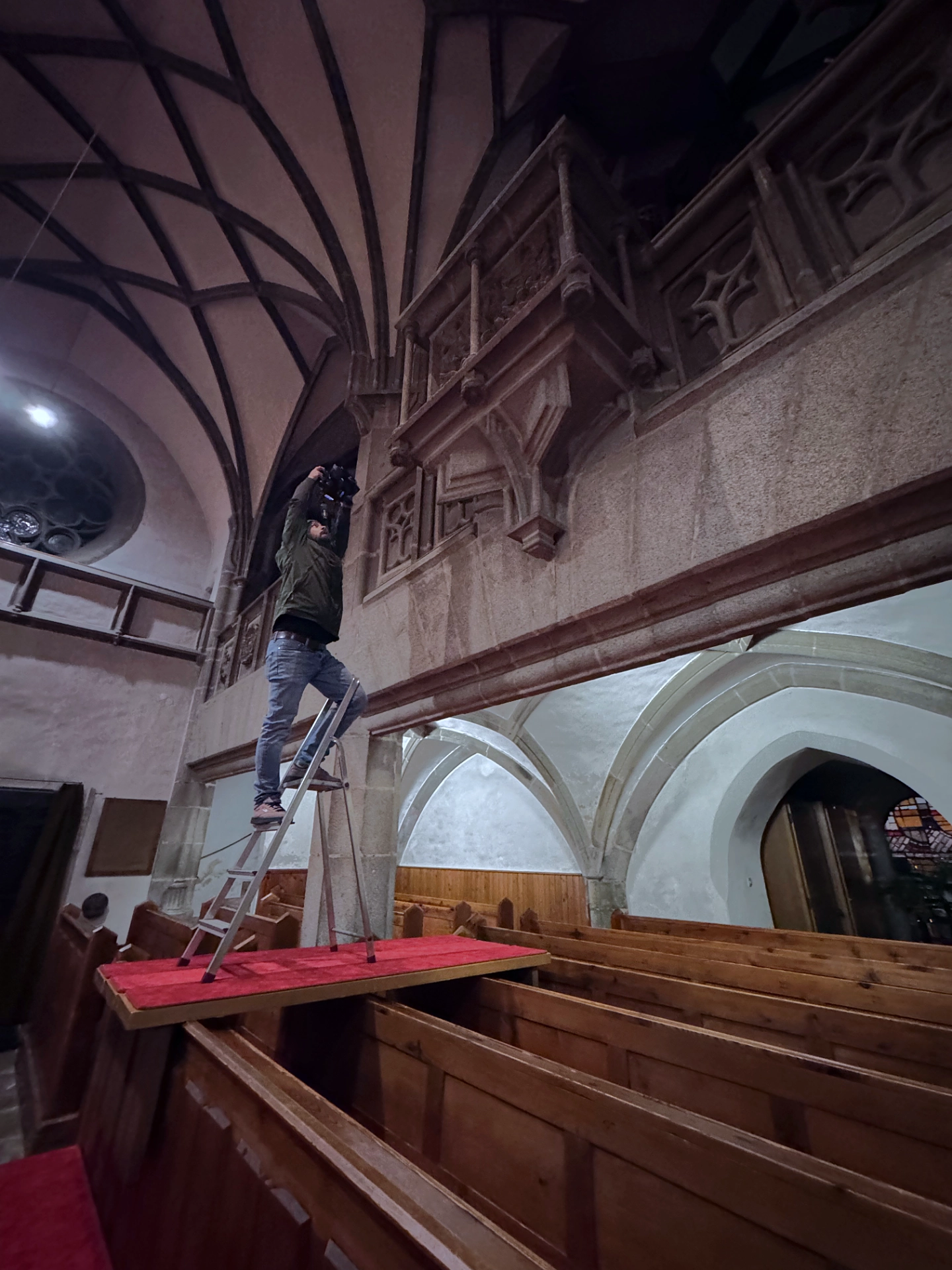
A picture really is worth one thousand words. Behold a professional scanner with his professional ladder equipment.
EMPORE ROUND 1
Well we knew that we had to scan this “Empore” or gallery in plain english. It was 7th of November 2025, around 18:00. We were pretty advanced with the rest of the churches and we knew about this “bonuses” and we decided we will go with the “Empore” as the first. So we packed our gear and went to capture both the exterior of the church and also this gallery. We didn’t even knew what an “Empore” was like, how big it was, we knew nothing about it, just that its made out of stone and “we will know when we see it”
THE CAVEAT
Did we improvise on GOTIKSTRASSE? Sure we did!
Doing this project, sometimes you have to come up with “funny” solutions. We had to scan the gallery, but we didn’t knew how high it was and we didn’t even packed a ladder with us. So? Since we were already there and didn’t wanted to drive again another day, we improvised on the spot. Using the “trust me, I’m an architect” method, we build ourselves a “construction” with things that we found inside the church to be able to reach and scan the subject.
The caveat was, that after we finished collecting the data, we shared this with the GOTIK team and to our surprize, we had to scan the whole gallery, not only the center part. So we had to do it all over again.
You can imagine how frustrating this was…
EMPORE ROUND 2
Back to square one. But this time we packed everything and brought a ladder with us. We scanned it with a Godox Wistro AR400 cross lighting setup and we also used stationary fill lights, since the subject was really big. After shooting thousands of RAW photos, time to turn the lights off and go home and start the workstation.
But still, it wasn’t enough. We had to go back again the next day with the Photomast, to capture the top part of the whole gallery.
SKETCHFAB 3D
For the final submission, we published the 3D scan model with only the color information on SKETCHFAB and implemented it on the official GOTIKSTRASSE website. It was very fun to do, but the roadmap of the asset will not stop here. There is ton of work to be done on it such as retopology, PBR materials, synthetic gaussian model and much more. But, I will let you explore the website more.
QUICK DISCLAIMER: the uploaded model on sketchfab is a low version in terms of quality and texture resolution, in order to fit under 500 mb.
HIRSCHBACH ATTIC AKA “BAT COUNTRY”
Our last “bonus” was a whole attic in a near pitch black environment. Basically we had to climb into a very old gothic church roof attic, full with dust, spiders, wasps and BATS, and of course scan it. What could go wrong, right?
BUSHMAN
Okay, in order to scan this whole thing, we partnered with BUSHMAN PANORAMIC to test some lighting equipment with the Xgrids Portalcam. We used 2 Halo Pro lights with a bracket, mounted it and started scanning after exploring the attic a little bit and we thought it was safe enough.
SAFE ENOUGH
All systems go! We started scanning and testing out the BUSHMAN equipment. Slowly, this part of the project transformed itself into a scanning equipment review. We tested and tried a lot of different options and went with the one that worked best. We tackled everything with an open-minded approach.
BATS
Well, just like with the “Empore” where we forgot to bring a ladder, here we made sure that we had everything we need, BUT we didn’t thought about the “usual suspects” when you go into such an environment. So, as my partner in crime JeanClaude was scanning the very top of the attic (this thing was massive, it had 3 levels) he encountered the natural inhabitants of this attic and the whole situation went from happily testing out new equipment and scanning the attic into “let’s get the hell out of here”. Swarms of bats started making sounds and flying aggressively all over the place. So we got to get the hell out of dodge and be careful not to fall between the wooden beams.
GAUSSIAN SPLATTING
This is the new kid on the block in the scanning field and also in the way we present 3D data.
Gaussian Splatting turns ordinary photographs into an immersive, navigable 3D scene. For Gotikstrasse, it lets us preserve the space’s atmosphere, material detail and shifting perspectives in a way that static images cannot.
Each Church had to have its interior turned in a gaussian model for interactive exploration on the website.
3DGS
So, with this new technology, we were able to present the beautiful gothic interiors of the churches in a .ply format that is easy to embed on websites and the data is light to be shared. The beauty of using gaussian splats for scans is that it enables the viewer to freely walk around and explore the environments at his own pace.
DIFFERENT WORKFLOWS
We tested a lot of workflows on how to produce these gaussian splats models or 3DGS. First we started with a more robust workflow of scanning using camera and tripod setup, but that involved a lot of manual work and time. The splat model is far superior using this method, but our problem was time. It was running too fast and the project deadline was casting a very long shadow over us. Of course we postponed the deadline. Of course we had to postpone it again and again. So we decided to go with a more automated way of producing 3DGS models for the interiors. And the answer for us was Portal Cam from Xgrids.
ST PETER
For MADCHAMO, the first gaussian test was for the St. Peter church where over 9000 photos were shot. The interior photogrammetry mesh was top notch, but as we were testing the 3DGS workflow, it took us the whole St. Peter church process to realize what actually maters when producing quality gaussian models. Light consistency and angle coverage are much more important than the total number of photos. But, first, you have to fail in order to know how it works.
A PROPER ONE?
As we were pushing up with the project and learning a ton of things with each completed church, we have our gems that are worth presenting as a study case on how a proper gaussian model should look like. Below is one of our best examples. There are much more, but those can be explored through the official GOTIKSTRASSE website.
UNREAL ENGINE ANIMATIONS
Another thing that we had to do is turntable animations for all the churches, and we achieved that by using Unreal Engine and creating a virtual studio template where we rendered them.
DIORAMAS
The initial vision was to make small dioramas for each church. To create a small period environment for each one and present the animations as single “medieval” pieces, digitally reconstructed. It turned out that the ambition was a bit bigger than our time capabilities back then, and we decided to simplify them into simple white turntables. Sometimes you need to make compromises like this in order to close the chapter, but in the future we maybe make some just for the sake of presentation.
END OF THE LINE
As we reach the end of the project and we submitted everything to the rest of the team, the noise and the madness stopped all of a sudden. There was no constant processing & capturing adventures, no more troubleshooting & active working hours after 12. There was a well deserved silence for a while, silence that we used to reflect upon on what we did and how to be better next time. And this is the message that I would like to live you with, after reaching this point in the article:
“If you don’t like something, don’t do it! You will never be good at something that you don’t like! Make something special, make a difference. Don’t skip the process.” – Cosmin Cazacu | Owner and founder of MADCHAMO
Thank you for time reading this and we hope you learned something new or if you are a veteran in this field, we hope you got inspired by our work.
Till next time!


